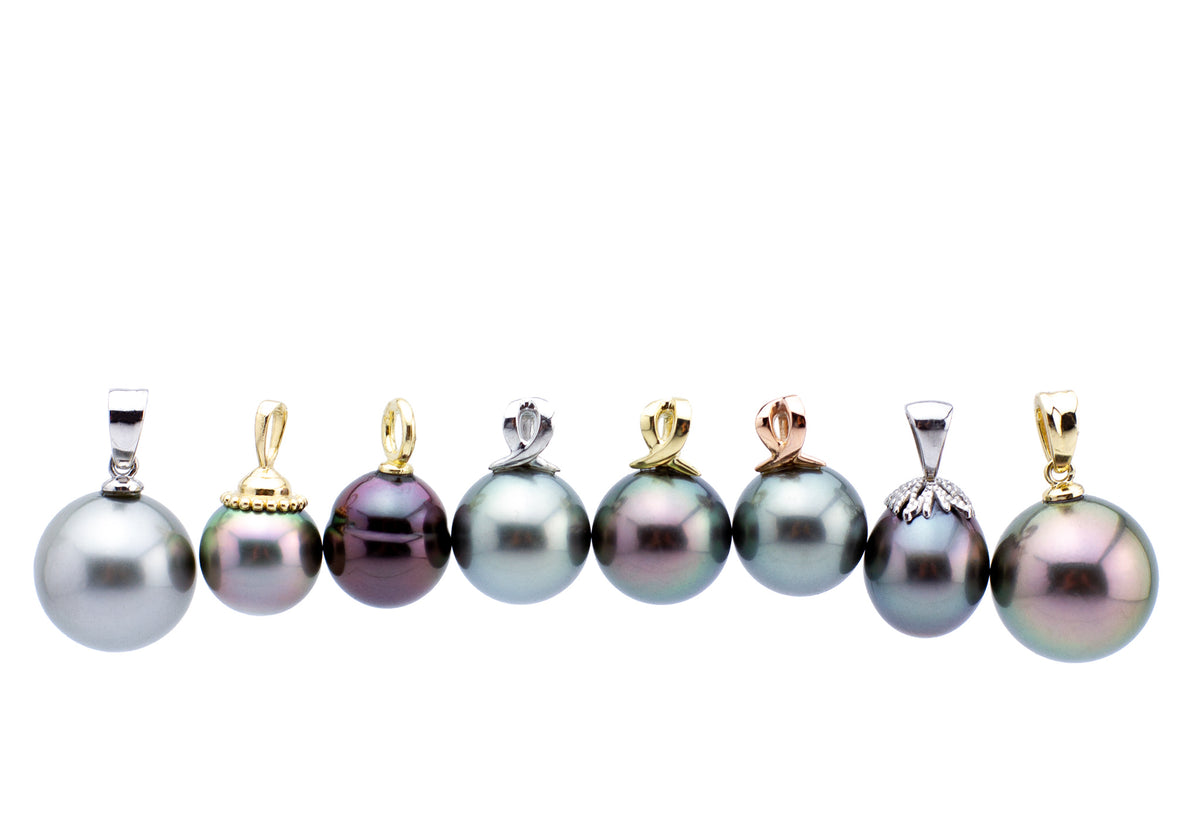
Tahitian Pearl Colors Explained: A Complete Color Guide


Ask ten people to describe a Tahitian pearl and most will say "black." Then put a real one in their hand and watch their face change. Up close, Tahitian pearl colors are anything but plain: deep greens, glowing pinks, smoky purples, icy silvers, and flashes of blue that shift every time the pearl moves.
We see this reaction all the time. Someone walks in expecting a simple black bead and leaves talking about "the green one with the pink glow." That glow is what makes these pearls so special, and also what makes them a little confusing to shop for.
This Tahitian pearl color guide clears it up. You'll learn where the colors come from, what words like peacock and aubergine really mean, which shades are rarest, how color affects price, and how to spot a dyed pearl. By the end, you'll know exactly which color speaks to you, and why.
Where Do Natural Tahitian Pearl Colors Come From?

Every Tahitian pearl grows inside the Pinctada margaritifera, better known as the black lipped oyster. It lives in the warm lagoons of French Polynesia, and the inside of its shell is lined with dark, rainbow sheened nacre. The pearl takes its color from that same nacre, layer by layer, over about two years.
Why are Tahitian pearls dark?
The black lipped oyster naturally produces dark pigments in its nacre. When a pearl forms, those pigments build up in the same way they do in the shell lining. That's why natural Tahitian pearl colors lean darker than Akoya or South Sea pearls, which come from oysters with white or golden lips.
Are Tahitian pearls naturally colored or dyed?
Genuine Tahitian pearls are naturally colored. No dye is needed to get those greens and purples. A few things shape the final shade:
- The oyster itself. Each oyster has its own color tendencies.
- The graft. Farmers place a tiny piece of mantle tissue from a donor oyster inside the host oyster. That donor tissue strongly influences the color.
- The lagoon. Water temperature, food, and depth all play a part.
Think of it like wine grapes: same vine, different hillside, slightly different flavor. You can read more about the process on our Tahitian pearl farming page.
Body Color vs. Overtone: The Two Layers of Every Pearl
Before we get into the Tahitian pearl color chart, there's one idea that makes everything click. Every Tahitian pearl has two layers of color.
- Body color is the main color you notice first, like black, gray, or silver.
- Overtone is the softer, translucent color that seems to float on the surface, like green, pink, or blue.
Here's a simple way to picture it. Imagine a black car parked under a sunset. The paint is black (body color), but the shine across the hood glows orange and pink (overtone). Pearls work the same way.
This is why two pearls that are both "black" can look completely different. One might have a cool blue overtone, while the other glows with warm rose. When jewelers name a pearl's color, they're usually describing both layers together.
Tahitian Pearl Color Chart: The Main Color Families
So, what colors do Tahitian pearls come in? Nearly every shade from snowy silver to inky black, with overtones across the rainbow. Here's a quick Tahitian pearl color chart, followed by a closer look at each family.
|
Color |
What it looks like |
Feels like |
|
Peacock |
Dark green gray body with rose, purple, and gold flashes |
Rich, dramatic, a true showstopper |
|
Aubergine |
Deep purple, like the skin of an eggplant |
Moody and elegant |
|
Pistachio |
Soft yellowish green, sometimes with gold |
Fresh, warm, unusual |
|
Green |
Forest to seafoam green |
Natural, ocean inspired |
|
Blue |
Steely to sky blue, often over gray |
Cool and calm |
|
Silver |
Light, bright, metallic gray |
Bright, modern, easy to wear |
|
Black |
Charcoal to near jet black |
Classic and bold |
Peacock Tahitian pearl
The peacock Tahitian pearl is the one people fall for. It has a dark body, usually green gray, with overtones of rose, aubergine, and sometimes gold. Turn it in the light and the colors ripple like a peacock's tail feathers. It's one of the most sought after shades in the trade.
Aubergine Tahitian pearl
An aubergine Tahitian pearl carries a deep purple tone, named after the French word for eggplant. Some lean almost plum, others reddish purple. They look stunning against gold and pair beautifully with greens in a mixed strand.
Pistachio Tahitian pearl
The pistachio Tahitian pearl has a soft, yellowish green body that surprises people who expect dark pearls. These lighter, warmer tones are less common, and they bring a fresh, almost sunny feel to a piece.
Green Tahitian pearl
A green Tahitian pearl can range from deep forest green to a light seafoam. Green is one of the most common overtones in Tahitian pearls, which makes it a great starting point for first time buyers.
Blue Tahitian pearl
A blue Tahitian pearl usually has a gray or silver body with a cool blue overtone. True, vivid blue is less common, so a pearl with a strong, clean blue glow is a real find.
Silver Tahitian pearl
A silver Tahitian pearl sits at the light end of the range. Bright and metallic, silver pearls often show delicate pink or blue overtones. They're a favorite for everyday wear because they go with everything.
Black Tahitian pearl colors
Black Tahitian pearl colors cover the deepest end, from charcoal to near jet black. A truly black pearl with almost no overtone is actually quite rare. Most "black" Tahitian pearls show at least a hint of green, blue, or purple when you look closely.
Rarest and Most Valuable Tahitian Pearl Colors
Strong, saturated peacock and true jet black with intense luster are among the hardest to find. Very light and unusual shades, like bright pistachio, clean blue, or near white, are also uncommon because the black lipped oyster leans dark by nature.
What is the most valuable Tahitian pearl color?
Peacock usually commands the highest prices, followed closely by deep aubergine and rich, glowing dark greens. Buyers pay more for colors that are vivid and show several overtones at once.
Does color affect the price of a Tahitian pearl?
Yes, but it's only one piece of the puzzle. Color works together with:
- Luster, the brightness and mirror like shine. A dull pearl in a rare color is still a dull pearl.
- Surface quality, how clean the surface is. Learn more in our Tahitian pearl grading guide.
- Size, since larger pearls take longer to grow. See which pearl size is right for you.
- Shape, with round pearls usually priced highest.
Here's our honest take: the "best" color is the one you love wearing. A pearl that makes you smile every time you catch it in the mirror is worth more to you than any price chart.
How Can You Tell If a Tahitian Pearl Is Real or Dyed?
Because dark pearls are so popular, some sellers dye cheaper freshwater or Akoya pearls black and sell them as "Tahitian." Here are a few signs to watch for:
- Color that looks too perfect. Natural pearls in a strand vary slightly. A row of identical, flat black beads is a red flag.
- No overtone. Real Tahitian pearls almost always show some green, pink, blue, or purple glow. Dyed pearls tend to look one dimensional.
- Color pooling. Look near the drill hole or any small blemish. Dye often collects there and looks darker.
- A price that seems too good. Genuine Tahitian pearls take years to grow, so they're rarely cheap.
The simplest protection is buying from a trusted source that can tell you exactly where its pearls come from. At Kamoka Pearl, our pearls are grown on our own family farm on Kamoka Atoll, so we know each one's story from oyster to clasp.
How to Choose Your Tahitian Pearl Color

Still not sure which shade is "you"? These quick tips help:
- Match your metal. Warm colors like aubergine, pistachio, and peacock glow against yellow or rose gold. Cool tones like silver, blue, and gray shine on white gold or sterling silver.
- Think about your skin tone. Silver and light pearls brighten fair skin. Deeper greens and peacock look rich on olive and darker skin. Honestly, though, almost every Tahitian pearl color flatters everyone.
- Check it in daylight. Indoor lighting can flatten overtones. Natural light shows a pearl's true personality.
- Consider how you'll wear it. For everyday pieces, versatile greens and silvers are easy wins. For a statement piece, go bold with peacock or a mixed color strand.
- Shopping for him? Darker greens, charcoal, and peacock are popular picks in our Tahitian pearls for men collection.
Want to see the full range side by side? Browse our loose Tahitian pearls or visit our Tahitian pearl colors and luster page for more close up photos.
Tahitian Pearl Colors FAQ
Are Tahitian pearls always black?
No. Despite the "black pearl" nickname, Tahitian pearls come in silver, gray, green, blue, pistachio, aubergine, peacock, and more. Black is just one part of a much bigger palette.
What is a peacock Tahitian pearl?
A peacock Tahitian pearl has a dark green gray body with overtones of rose, purple, and gold. The mix of colors looks like a peacock feather, which is how it got its name.
What is the difference between body color and overtone?
Body color is the main color of the pearl. Overtone is the translucent glow that sits on top of it. Together, they create the pearl's full color.
Do Tahitian pearls change color over time?
With good care, no. Keep them away from harsh chemicals, perfume, and long sun exposure to protect their luster. Our caring for Tahitian pearls guide covers the basics.
Find the Tahitian Pearl Color That Feels Like You
Tahitian pearl colors are far richer than the "black pearl" label suggests. Here's what to remember:
- Every Tahitian pearl's color is natural, shaped by the oyster, the graft, and the lagoon.
- Body color is the main shade; overtone is the glow on top.
- Peacock and aubergine are among the most prized, but every shade has its own charm.
- Luster, surface, size, and shape matter just as much as color.
- If a pearl looks too uniform or too cheap, ask questions.

The best way to understand these colors is to see them for yourself. Explore our new arrivals, each photographed so you can see its true color and overtones, straight from our farm on Kamoka Atoll.
Have a color in mind but can't find the right piece? Contact us and we'll help you hand pick the perfect pearl.