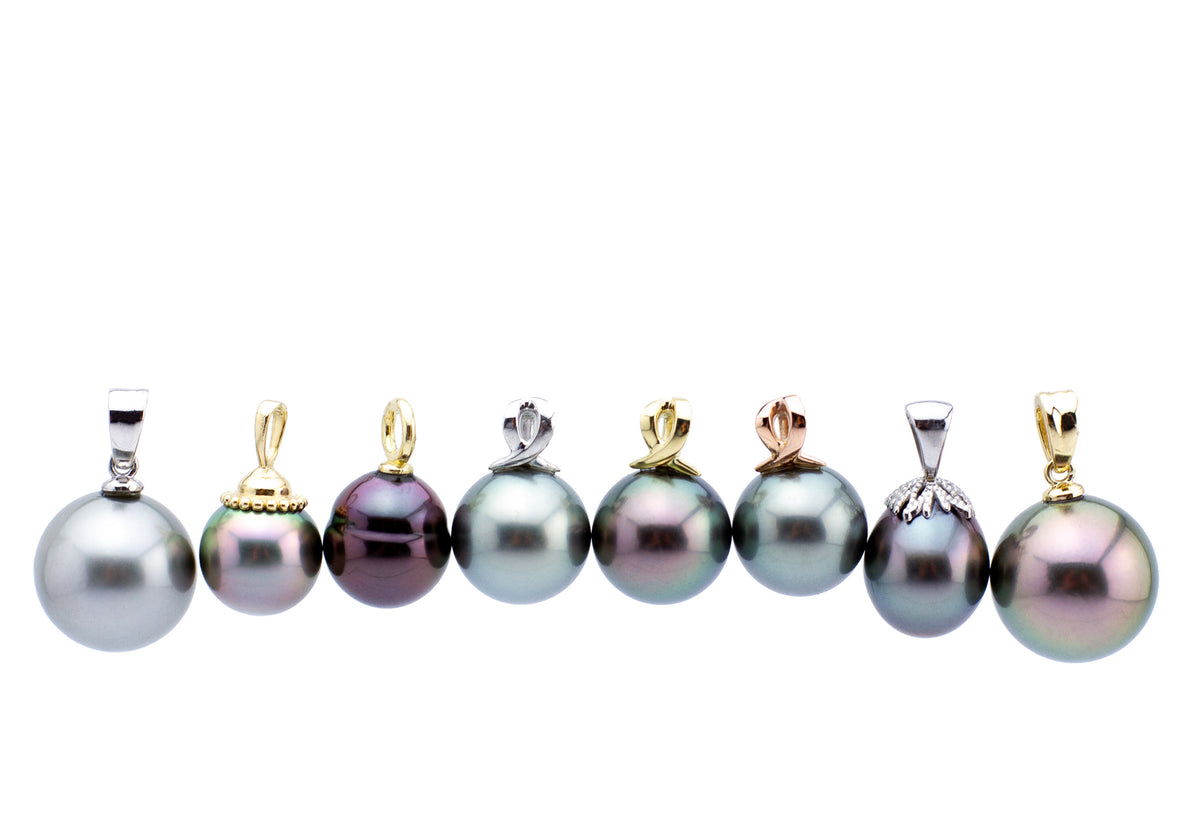
Why Are Black Pearls Valuable? The Beauty of Tahitian Pearls

“Black pearl” is the phrase most people search for, but most Tahitian pearls are rarely pure black. That is part of what makes a truly pure black pearl so special: when one does appear, its rarity can make it especially valuable.
They can reveal charcoal, silver, green, blue, purple, and peacock tones as they move through the light. Their beauty comes from that natural depth of color, along with luminous reflections, distinctive shapes, and the individual character that makes every pearl different.
Tahitian pearl jewelry is valued not simply because it is dark, but because exceptional pearls are difficult to cultivate, select, and match. Here is what makes them special—and what to look for when choosing one.
What Makes Black Pearls Valuable?
The value of a Tahitian pearl comes from how its qualities work together. A pearl may be large, but lack luster. It may be beautifully colored, but have a heavily marked surface. The most compelling pearls balance several characteristics at once.
The seven key factors are:
• Color: Tahitian pearls are known for naturally dark body colors and striking overtones, from silver and green to blue, purple, and peacock.
• Luster: Strong luster gives a pearl bright, crisp reflections and visual depth.
• Size: Larger pearls are generally more difficult to produce and can be more valuable when other qualities are strong.
• Shape: Perfectly round pearls are traditionally prized, while drops, ovals, and baroque forms can be especially compelling for their character.
• Surface: Fewer or less noticeable surface characteristics generally increase a pearl’s desirability.
• Nacre: Healthy nacre contributes to a pearl’s durability and luminous appearance.
• Matching: In earrings, bracelets, and necklaces, finding pearls that harmonize in color, size, shape, luster, and surface requires careful selection.
A pearl’s value is never determined by color alone. The most memorable Tahitian pearls have presence: a beautiful balance of luster, color, shape, and individuality.
Are Tahitian Pearls Naturally Black?
Tahitian pearls are naturally dark, but very few are truly pure black.
Their body colors may range from gray and silver to green, brown, and deep charcoal. Overtones can add flashes of blue, purple, rose, or peacock. That complexity is what gives Tahitian pearl jewelry its distinctive character.
The term “black pearl” is useful, but it can hide the full spectrum of color. Because pure black pearls are so rare, a truly black Tahitian pearl with strong luster can be more valuable than one with more common colors. Whatever the color, the finest pearls have depth, movement, and a natural response to light.
Are Black Pearls Rarer Than White Pearls?
Naturally dark pearls are less commonly encountered than the classic white pearls many people associate with pearl jewelry. Still, color alone does not make a pearl rare or valuable.
Within Tahitian pearls, the most difficult combinations to find are often those that bring together large size, sharp luster, clean surface, desirable color, strong nacre, and an appealing shape. For multi-pearl jewelry, close matching adds another layer of rarity.
This is why a well-matched black pearl necklace or pair of black pearl earrings can be especially remarkable. Each pearl must look beautiful individually while also belonging together as a complete piece.
Why Are Tahitian Pearls So Expensive?
Tahitian pearls are cultivated over time in French Polynesia, where pearl farming requires patient care and close attention to each harvest.
Not every cultivated pearl develops the combination of qualities desired for fine jewelry. Once pearls are harvested, they must be evaluated for color, luster, size, shape, surface, nacre, and overall visual balance. The selection process becomes even more exacting when pearls are being matched for earrings, bracelets, or necklaces.
The price of a Tahitian pearl reflects more than its size or color. It reflects cultivation, selection, craftsmanship, and the scarcity of a particularly beautiful individual pearl.
How Much Are Black Pearls Worth?

There is no single answer because black pearl value varies widely.
A smaller pearl with modest luster or visible surface characteristics may be relatively accessible. A larger Tahitian pearl with strong luster, vivid natural overtones, clean surface, and exceptional nacre may be considerably more valuable.
At Kamoka, our Tahitian pearl jewelry starts at around $100 for a pitted pearl necklace, where the pearl shows natural surface marks, and our finest matched strands have sold for about $20,000.
Every so often, our harvest produces an exceptional individual pearl valued at more than $100,000. Pearls of that rarity are not used in our retail jewelry; they are usually sold at auction to other jewelers.
When considering a pearl, look beyond the question of price and ask:
• Does the pearl have sharp, lively luster?
• Is its color natural, nuanced, and appealing?
• Does the surface support its overall beauty?
• Is the size and shape right for the design?
• If there is more than one pearl, how well do they match?
• Does the jewelry feel like something you will genuinely enjoy wearing?
The best pearl is not always the darkest, roundest, or largest. It is the one whose qualities come together in a way that feels unmistakably beautiful.
How Can You Tell If a Tahitian Pearl Is High Quality?
Start with luster. Under good light, a high-quality pearl should show bright, relatively sharp reflections rather than looking dull or chalky.
Then look at color and overtone. Tahitian pearls can reveal green, blue, purple, silver, or peacock tones. The most appealing colors are not necessarily the most dramatic; they are the ones that feel alive and balanced on the pearl.
Next, examine the surface. Natural surface characteristics are normal. What matters is how visible they are and whether they distract from the pearl’s overall appearance.
Finally, consider the pearl as a whole. A baroque pearl with extraordinary luster and color can be more compelling than a round pearl with less life. A pearl should be chosen for its complete character, not by a single checklist item.
What Is the Most Valuable Type of Black Pearl?
There is no one “most valuable” black pearl.
Exceptional Tahitian pearls are often prized when they combine large size, outstanding luster, beautiful natural color, strong nacre, a clean surface, and desirable shape. Peacock overtones and rare, truly pure black pearls can be especially sought after, but personal taste matters too.
Value also depends on the finished jewelry. A well-matched strand, bracelet, or pair of earrings requires more selection than a single pearl pendant because every pearl must work in harmony with the others.
Black Pearl Jewelry for an Individual Style
Tahitian pearl jewelry offers a different experience from traditional white pearl jewelry.
A black pearl pendant can make a single pearl the focal point. Black pearl earrings can bring depth and color close to the face. A bracelet or necklace can show how beautiful these pearls become when thoughtfully matched.
Their naturally dark colors create contrast, while their overtones keep them from ever feeling flat. One pearl may show a quiet silver glow; another may reveal green, blue, or peacock tones. That individuality is part of the appeal.
Are Black Pearls a Good Investment?
Black pearls are best chosen as fine jewelry, not as a guaranteed financial investment.
Their future value can depend on quality, craftsmanship, provenance, market demand, condition, and many other factors. The more meaningful question is whether the pearl has lasting beauty and whether it is a piece you will want to wear for years.
Choose a pearl with excellent luster, natural color, thoughtful craftsmanship, and character that speaks to you. Its value should begin with the pleasure of owning and wearing it.
Why Tahitian Pearls Are So Special
Tahitian pearls are not simply black gemstones. They are natural products shaped by biology, cultivation, environment, and time.
Their colors are complex. Their forms are individual. Their luster can feel almost luminous. No two pearls develop in exactly the same way, which means each finished piece of Tahitian pearl jewelry carries its own character.
That is what makes Tahitian pearls so compelling: they offer beauty that is not uniform, but alive.
How We Select Pearls on Our Farm
We have been growing Tahitian pearls on our remote atoll in French Polynesia since 1991, and three generations of our family have sorted every harvest by hand. Each pearl is judged on the same qualities described above, luster first, then color, surface, and shape. Only the pearls that come together beautifully become Kamoka jewelry.
Frequently Asked Questions About Black Pearls
Why are black pearls so valuable?
Black pearls can be valuable because of their color, luster, size, shape, surface quality, nacre, matching, and the care required to cultivate and select exceptional pearls.
Are black pearls rarer than white pearls?
Naturally dark pearls are less commonly encountered than classic white pearls, but not every dark pearl is rare. Value depends on the quality of the individual pearl and, for jewelry with multiple pearls, how closely they match.
Why are Tahitian pearls expensive?
Tahitian pearls require time and careful cultivation. Only some develop the combination of luster, color, size, nacre, shape, surface, and matching needed for fine jewelry.
Are black pearls naturally black?
Tahitian pearls have naturally dark body colors, but they are not always truly black. They may appear gray, silver, green, brown, blue, purple, or peacock depending on their color and overtone. A truly pure black pearl is rare and can be more valuable.
How much is a black pearl worth?
It depends on the pearl’s quality. Kamoka’s Tahitian pearl jewelry ranges from around $100 to about $20,000, and rare individual pearls from our harvest can be valued at more than $100,000.
How can you tell if a Tahitian pearl is high quality?
Look for strong luster, appealing natural color, healthy nacre, good surface quality, desirable size and shape, and an overall appearance that feels balanced and alive.
Discover Kamoka’s Tahitian Pearl Jewelry

A Tahitian pearl is more than a color. It is a combination of natural variation, luminous luster, individual form, and thoughtful craftsmanship.
Explore Kamoka’s Tahitian pearl jewelry to find a pearl with character that is uniquely yours.