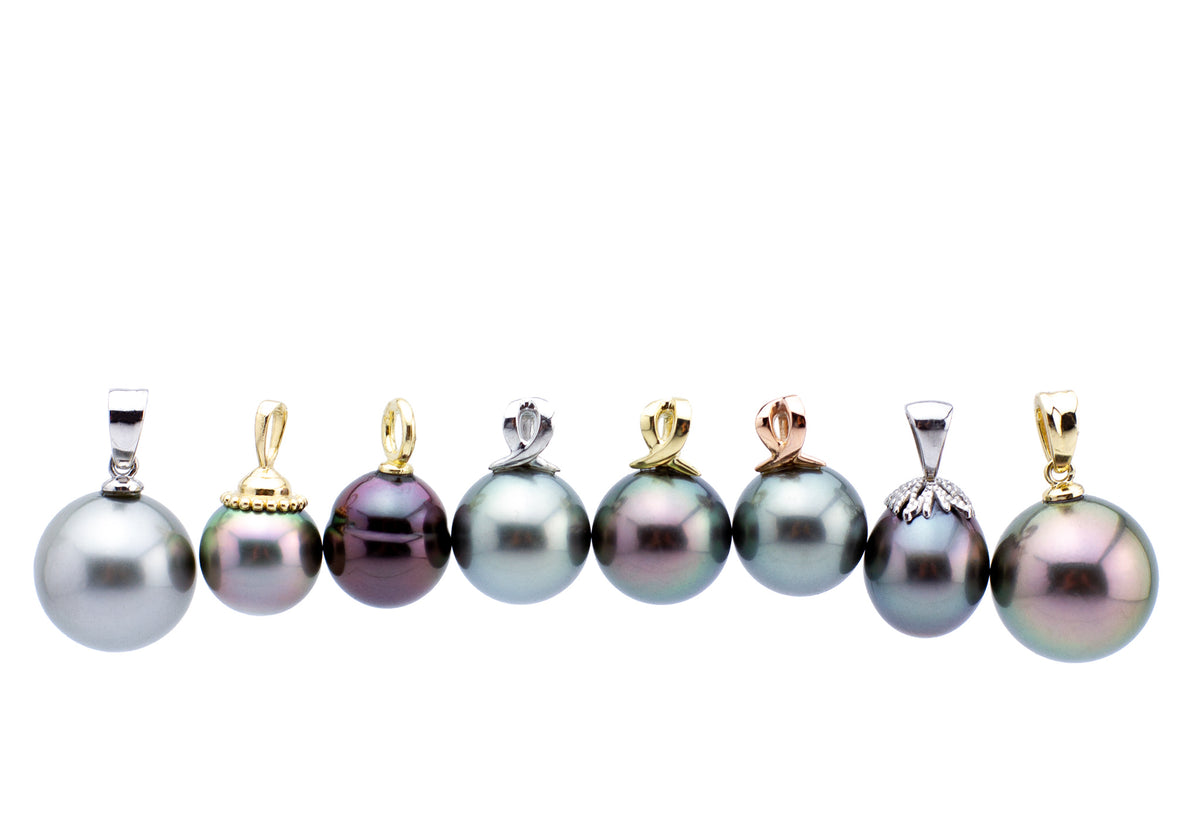
What Makes Tahitian Pearls So Unique?


Hold a Tahitian pearl up to the light and something unexpected happens. What looked black a moment ago suddenly flashes green, then rose, then a deep peacock blue. No other pearl in the world does quite this, and that is just the beginning of what makes Tahitian pearls so special.
In this guide, we will explain what Tahitian pearls are, where they come from and why they stand apart from every other pearl. You will learn how they are grown, how they compare to Akoya and South Sea pearls, what drives their value and how to make sure you are buying the real thing.
We farm our own pearls in the lagoons of French Polynesia, so this is a story we get to live every day. Let's start at the beginning.
What Are Tahitian Pearls?
Tahitian pearls are saltwater cultured pearls grown in one specific oyster, the black lip pearl oyster (Pinctada margaritifera), in the warm lagoons of French Polynesia. They are famous for their dark, naturally colored nacre and their shifting rainbow of overtones.
Where do Tahitian pearls come from?
Despite the name, Tahitian pearls are not grown on the island of Tahiti itself. They come from the remote atolls of French Polynesia, mainly in the Tuamotu and Gambier archipelagos, scattered across the South Pacific. Tahiti is simply the main trading hub, so the name stuck.
These lagoons are some of the cleanest waters on earth. That matters, because pearl oysters are sensitive creatures. They only thrive where the water is clear, warm and full of natural plankton.
Are Tahitian pearls real pearls?
Yes. Real Tahitian pearls are genuine pearls grown inside a living oyster. They are "cultured," which means a skilled technician places a small bead and a piece of tissue inside the oyster to start the process. From there, the oyster does all the work, coating the bead in layer after layer of nacre for years. The result is a real pearl, made by nature, with a little help from people.
What Makes Tahitian Pearls Unique?

So what sets unique Tahitian pearls apart from everything else in a jewelry case? It comes down to four things.
1. The black lip oyster pearl
The Tahitian pearl oyster is the world's best known source of naturally dark pearls. Open one up and you will see that the inside edge of its shell is lined with a dark, almost black band, which gives the oyster its name. That same pigment flows into every black lip oyster pearl it grows.
2. Natural colors no one can copy
Are Tahitian pearls naturally black? Yes, their dark color is completely natural, but "black" barely tells the story. Tahitian pearl colors range from silvery white to charcoal, layered with overtones of green, blue, pink, gold and purple. The famous peacock shade blends several of these at once.
Think of it like a fingerprint. Even pearls from the same oyster batch never look exactly alike. Want to go deeper? Read our guide to Tahitian pearl colors and luster.
3. Generous size
Tahitian black pearls are naturally larger than most pearl types. Most fall between about 8mm and 14mm, and exceptional ones grow even bigger. That size gives them real presence, whether set in a ring or worn on a leather necklace.
4. Thick, lustrous nacre
Tahitian pearls spend years building nacre, the material that gives pearls their glow. Thicker nacre means deeper luster and a pearl that holds up beautifully over time with basic care.
Inside Tahitian Pearl Farming
Tahitian pearl farming is slow, hands on work, and much of it depends on nature cooperating.
How long does it take to grow a Tahitian pearl?
All in, it usually takes around four to five years from baby oyster to harvested pearl. Here is the journey:
- Raising the oyster. Young oysters grow in the lagoon for roughly two to three years until they are big enough to be grafted.
- Grafting. A skilled technician places a round nucleus and a tiny piece of mantle tissue from a donor oyster inside each one.
- Growing. The oysters go back into the lagoon for about 18 months to two years while they coat the nucleus in nacre. Farmers clean and check them by hand along the way.
- Harvest. Each pearl is removed, sorted and graded. Healthy oysters can often be grafted again to grow another pearl.
It is a lot like making a fine wine. You do the careful work up front, then you wait, and you never know exactly what you will get until the end.
Natural and sustainable Tahitian pearls
Pearl oysters only survive in clean, healthy water, so a pearl farm has every reason to protect its lagoon. In that sense, a pearl is a small proof that the ocean around it is thriving. At our farm, sustainability guides how we raise oysters and care for the reef. You can read more on our sustainability page and our overview of Tahitian pearl farming.
Tahitian Pearls vs Akoya and South Sea Pearls
The three most popular saltwater pearls each have their own personality. Here is how they compare at a glance.
|
Feature |
Tahitian pearls |
Akoya pearls |
South Sea pearls |
|
Oyster |
Black lip (Pinctada margaritifera) |
Akoya (Pinctada fucata) |
Gold lip and silver lip (Pinctada maxima) |
|
Main origin |
French Polynesia |
Japan and China |
Australia, Indonesia, Philippines |
|
Natural colors |
Silver to black with rich overtones |
White and cream with rose or silver |
White, silver and gold |
|
Typical size |
About 8 to 14mm |
About 6 to 9mm |
About 10 to 15mm and up |
|
Look |
Exotic, colorful, bold |
Classic, crisp, mirror bright |
Large, soft, satiny glow |
What is the difference between Tahitian pearls and Akoya pearls?
Akoya pearls are the classic white pearls you might picture on a grandmother's strand. They are smaller and known for sharp, mirror like shine. Tahitian pearls are larger and come in dark, naturally colorful shades. If Akoya pearls are a crisp white shirt, Tahitian pearls are your favorite piece of statement art.
What is the difference between Tahitian pearls and South Sea pearls?
Both are large, thick nacred pearls from warm southern waters. The biggest difference is color. South Sea pearls come in white, silver and gold, while Tahitian pearls offer the dark, peacock range you will not find anywhere else. South Sea pearls also tend to run a little larger.
Tahitian Pearl Value and Quality

Why are Tahitian pearls so expensive?
Tahitian pearl value reflects how much goes into each one:
- Time. Four to five years of care for a single pearl.
- Risk. Storms, water changes and oyster health can wipe out a season's work.
- Low yield. Only a small share of each harvest has the luster, shape and surface to become fine jewelry.
- Remote locations. Farms sit on far flung atolls where everything, from fuel to equipment, has to be shipped in.
Are Tahitian pearls rare?
Yes, especially top quality ones. Perfectly round pearls with high luster, clean surfaces and vivid peacock overtones are a small fraction of any harvest. Every pearl is also one of a kind, so the exact pearl you fall in love with will never be grown again.
How is Tahitian pearl quality judged?
Graders look at five main factors: luster, surface, shape, size and color. Luster usually matters most, because it is what makes a pearl glow. Learn how we grade on our Tahitian pearl grading page.
Are Tahitian pearls worth the money?
If you want a piece that feels personal, natural and truly unique, we think so. With simple care, a quality Tahitian pearl can last for generations and become a family heirloom.
Do Tahitian pearls hold their value?
High quality pearls tend to keep their beauty and desirability, but it is best to buy them because you love them, not as a financial investment. Like most fine jewelry, resale prices are usually below retail. Their true value is in years of wear and the story they carry.
How Can You Tell if a Tahitian Pearl Is Real?
With so many "black pearls" for sale online, a few quick checks go a long way:
- Look for natural variation. Real pearls in a strand or pair differ slightly in color and overtone. Perfectly identical color can be a sign of dye.
- Turn it in daylight. Natural Tahitian pearl colors shift and glow as the pearl moves. Dyed or fake pearls tend to look flat.
- Check the drill hole. Dye often collects around the hole, leaving a darker ring.
- Try the tooth test. Gently rub the pearl against the edge of your front tooth. Real pearls feel slightly gritty, while plastic or glass feels smooth.
- Feel the weight. Real pearls feel cool and have a satisfying heft. Plastic imitations feel light and warm up quickly.
- Know your seller. A trustworthy seller can tell you exactly where and how a pearl was grown and offers a fair return policy.
Buying directly from a pearl farm is one of the easiest ways to know your pearls are natural Tahitian pearls with nothing hidden.
Frequently Asked Questions About Tahitian Pearls
What makes Tahitian pearls unique? They grow in the black lip oyster, which gives them naturally dark colors with shifting overtones, generous sizes and thick, glowing nacre.
Where do Tahitian pearls come from? The lagoons of French Polynesia, mainly in the Tuamotu and Gambier islands.
Are Tahitian pearls real pearls? Yes. They are genuine cultured pearls grown inside living oysters over several years.
Why are Tahitian pearls so expensive? Each one takes years to grow, farms face real risks and only a small share of the harvest reaches jewelry quality.
Are Tahitian pearls naturally black? Yes. Their dark tones come naturally from the oyster, and they also come in silver, gray and many colorful overtones.
How long does it take to grow a Tahitian pearl? About four to five years from young oyster to finished pearl, including around 18 months to two years of growth after grafting.
What is the difference between Tahitian pearls and Akoya pearls? Akoya pearls are smaller and usually white. Tahitian pearls are larger and naturally dark and colorful.
What is the difference between Tahitian pearls and South Sea pearls? South Sea pearls are white, silver or gold. Tahitian pearls offer darker shades and peacock overtones.
Are Tahitian pearls worth the money? For a natural, one of a kind piece that can last for generations, many people find they are.
How can you tell if a Tahitian pearl is real? Look for natural color variation, overtones that shift in daylight, a gritty feel in the tooth test and a seller who can confirm the origin.
Are Tahitian pearls rare? Top quality pearls with high luster, round shape and vivid color are rare, and every pearl is one of a kind.
Do Tahitian pearls hold their value? Quality pearls keep their beauty for generations, but buy them to wear and enjoy, not as a financial investment.
The Beauty of a One of a Kind Pearl

Tahitian pearls are unique because of where they come from and how they are made. Here is what to remember:
- They grow in the black lip oyster in the clean lagoons of French Polynesia.
- Their dark colors and shifting overtones are completely natural.
- They are larger than most pearls and take four to five years to grow.
- Luster, surface, shape, size and color all shape their quality and value.
- Buying from a trusted grower is the surest way to get real Tahitian pearls.
Ready to find your own? Explore our new arrivals for one of a kind pieces straight from our farm, or browse Tahitian pearl necklaces and earrings. Have a question about a pearl? Reach out to our team, and we will help you choose a pearl you'll treasure for years to come.