Tahitian Pearls vs Freshwater Pearls: What Is the Difference?


At first glance, pearls can look deceptively similar. A smooth surface and a soft glow show up on almost every strand. Look closer, though, and Tahitian pearls stand apart in almost every way that matters: a different mollusk, a different water, a color range no other pearl can match, and a farming process built around quality over quantity.
This guide walks through how Tahitian pearls compare to the more common freshwater pearl, so you understand exactly what makes the Tahitian pearls in our collection distinctive.
At a Glance
|
Feature |
Tahitian Pearls |
Freshwater Pearls |
|
Primary environment |
Saltwater lagoons |
Freshwater lakes and rivers |
|
Main mollusk |
Pinctada margaritifera (black lipped oyster) |
Freshwater mussels |
|
Typical colors |
Gray, charcoal, green, blue, purple, silver, with shifting overtones |
White, cream, pink, peach, lavender |
|
Common shapes |
Round, semi round, baroque, circled |
Round, oval, button, baroque, and more |
|
Nacre |
Generally thicker |
Typically composed almost entirely of nacre |
|
Farming approach |
Lower density, open ocean lagoons, slower and more selective harvest |
Higher density, shorter growing cycles, more frequent restocking |
|
Typical price |
Often higher, reflecting rarity and the farming process |
Generally more accessible |
|
Overall character |
Exotic, naturally dark, and distinctive |
Soft, versatile, and classic |
Where They Come From
The core difference starts with where and how each pearl grows.
Tahitian pearls are cultured in saltwater, exclusively in the lagoons of French Polynesia. They come from the black lipped oyster, Pinctada margaritifera, a species found almost nowhere else that naturally produces dark body colors with striking overtones no other oyster can replicate.
Freshwater pearls grow inside freshwater mussels, most often in lakes, rivers, and farming environments in China. A single mussel can produce many pearls at once, which is part of why freshwater pearls are so widely available and inexpensive by comparison.
That difference in habitat and mollusk is what gives Tahitian pearls their rarity: a limited environment, a single species, and a farming process that cannot be scaled up the way freshwater farming can.
Color: Where Tahitian Pearls Really Set Themselves Apart

Color is usually the first thing shoppers notice, and it is also where Tahitian pearls are most distinctive.
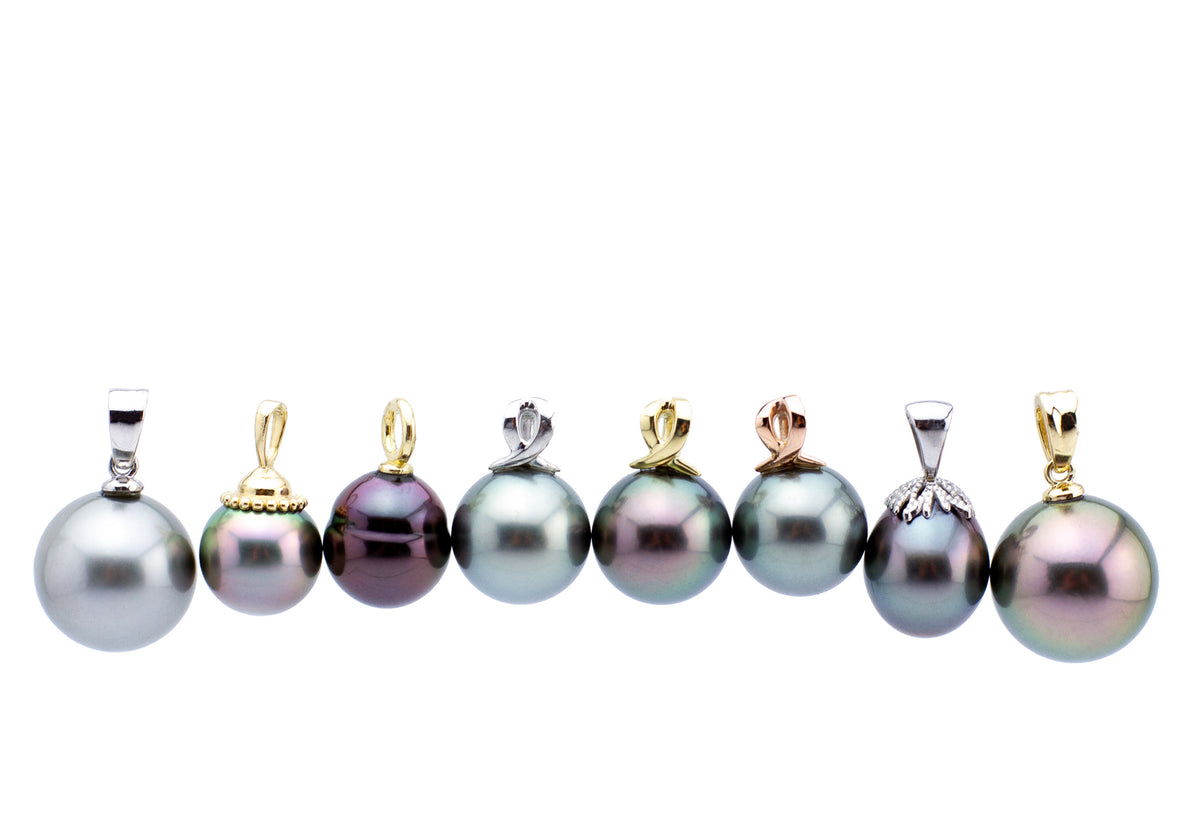
Tahitian pearls are often called black pearls, but true, solid black is actually one of the rarer colors in the range, most show a dark body color layered with shifting overtones, including:
- Charcoal and silver gray
- Peacock green
- Blue green and deep blue
- Purple and aubergine
A single pearl can shift between several of these colors depending on the light and the angle you view it from, which is a large part of why Tahitian pearls are considered so collectible. No two pearls, and no two pieces of jewelry, look quite the same.
Freshwater pearls, by contrast, stay within a narrower, softer palette: white, cream, pink, peach, and lavender. It is a familiar look, but not one that offers the same depth or variation.
Quality Considerations
Quality within any pearl category comes down to the same handful of things:
- Luster
- Surface quality
- Shape
- Size
- Color
- Nacre quality
- Matching, when several pearls are used together
Luster and surface quality matter most for an individual pearl. A pearl with strong luster looks vibrant and alive, while one with a heavily blemished surface looks less refined. Because Tahitian pearls are cultivated individually over a longer growing period, achieving that combination of luster, size, and clean surface at a high level is a real accomplishment, and part of why a well matched Tahitian pearl piece carries so much value.
Are They Real Pearls?
Yes, both are. This is one of the most common questions we get.
Both Tahitian and freshwater pearls are cultured pearls, meaning they form inside a living mollusk with some human assistance in the process, rather than forming entirely on their own. Cultured does not mean artificial or imitation. In both cases, the pearl itself is built from nacre by a living animal over time. The difference is the species, the water, and, in Tahitian pearl's case, the far more selective farming process behind it.
Want the full picture? Read our guide to Tahitian pearl farming or learn more about cultured pearls and lab grown gemstones.
Sustainability: Another Point in Tahitian Pearls' Favor

Tahitian pearl farming happens in open ocean lagoons, at a lower density per farm, with oysters given a longer growing period to produce a single, larger pearl. Because each oyster is handled individually and the growing cycle runs longer, harvests are smaller and far more selective by nature.
Freshwater pearl farming is typically set up very differently: mussels farmed at high density, a single mussel seeded to produce multiple pearls at once, and shorter growing cycles that mean more frequent restocking and more intensive use of the waterways involved.
Farmed responsibly, saltwater pearl cultivation in a natural lagoon environment is generally considered a lower impact way to produce pearls than high density freshwater farming, one more reason Tahitian pearls are worth the investment. Learn more about how we approach this in the Kamoka story.
Why Tahitian Pearls Command a Higher Price
Tahitian pearls are consistently more valuable than freshwater pearls, for a few clear reasons:
- Rarity. The dark colors and overtones the black lipped oyster produces are naturally limited, and true black is rarer still.
- Size. Larger pearls take longer to grow and are harder to produce. See our guide on finding the right pearl size.
- Shape. A perfectly round Tahitian pearl is genuinely difficult to cultivate, which adds to its value.
- Luster and surface quality. Exceptional luster and a clean surface can significantly raise a pearl's value.
- Matching. Assembling a necklace or a pair of earrings with pearls that closely match in size, shape, color, and luster takes real selection and craftsmanship.
How to Choose a High Quality Tahitian Pearl
Judge the individual pearl, not just the category it belongs to.
- Look for strong luster. A high luster pearl reflects light clearly and looks vibrant rather than dull.
- Check the surface. Minor natural marks are normal in an organic gemstone. What matters is how visible they are and whether they affect the overall look.
- Appreciate natural color. Do not hold out for a perfectly uniform black pearl. The shifting overtones are the point, not a flaw.
- Choose the right size. Larger pearls create more visual impact, while smaller pearls offer a quieter look.
- Think about the setting. A beautiful pearl deserves the right design, whether that is a classic necklace, a modern pendant, a bracelet, or a pair of earrings.
Beyond appearance, Tahitian pearls carry a sense of place. They grow in the lagoons of French Polynesia, where farmers work closely with living oysters and the surrounding marine environment. For shoppers who care about origin and craftsmanship as much as looks, that story makes a Tahitian pearl feel far more personal than a mass produced piece of jewelry. Once you own one, our guide to caring for Tahitian pearls will help keep it lustrous for a lifetime.
Frequently Asked Questions
What is the difference between Tahitian pearls and freshwater pearls? Tahitian pearls are cultured in saltwater lagoons by the black lipped oyster, Pinctada margaritifera, a rare species farmed at low density in French Polynesia. Freshwater pearls are cultured in freshwater mussels at much higher density. They differ in origin, color, farming approach, and price.
Are Tahitian pearls naturally black? Not usually. Tahitian pearls are naturally dark, but true solid black is one of the rarer colors. Most show charcoal, silver, green, blue, or purple overtones layered over a dark base, which is why they are commonly called black pearls even though flat black is uncommon.
Are Tahitian and freshwater pearls both real pearls? Yes. Both are genuine cultured pearls formed by living mollusks. Neither is synthetic or imitation.
Why are Tahitian pearls more expensive than freshwater pearls? Rarity, size, shape, luster, and the work involved in matching pearls for a finished piece. Tahitian pearls are farmed at low density with a long, selective growing cycle, which is part of what makes them a genuine investment piece rather than an everyday basic.
Discover the Beauty of Tahitian Pearls

Tahitian pearls offer something no other pearl can: naturally dark, shifting colors, a rare and selective farming process, and the character of pearls grown in the lagoons of French Polynesia.
Explore Kamoka Pearl's collection of handcrafted Tahitian pearl jewelry and find a pearl that is uniquely yours.