How to Tell if a Pearl Is Real: A Guide to Genuine Tahitian Pearls


A fake pearl can look remarkably convincing, even sitting right next to the real thing. If you are shopping for fine pearl jewelry, you may find yourself wondering how to tell if a pearl is genuine before you invest in it. The good news is that a handful of simple clues, from surface texture and luster to weight and overall character, can point you in the right direction.
For anyone drawn to Tahitian pearls specifically, knowing what to look for matters even more. These are pearls prized for a personality all their own, a natural depth of color, overtones that shift and flash with the light, and a kind of individuality no two strands ever quite repeat. In this guide, we will walk through how to spot a genuine pearl, which checks you can safely do at home, what to avoid, and when it is worth calling in a professional.
What Makes a Pearl Real?
Before you go looking for clues, it helps to know what "real" actually means.
Natural pearls form entirely on their own, without any human involvement. Cultured pearls form when a farmer introduces a small nucleus or piece of tissue into a mollusk, then lets the animal do what it does naturally: build layer upon layer of nacre around it. Both are genuine pearls.
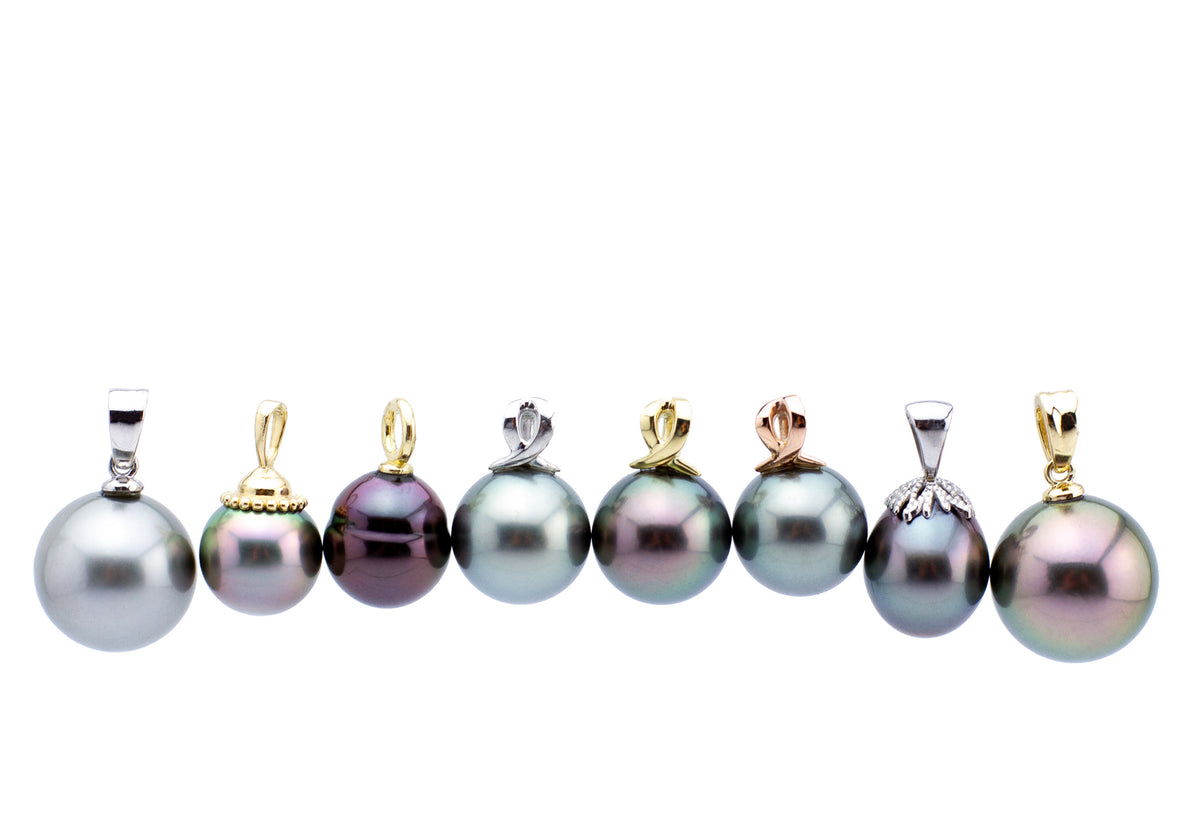
Tahitian pearls are cultured pearls, grown inside the black lipped oyster, Pinctada margaritifera, in the lagoons of French Polynesia. Their colors run from deep charcoal and true black through peacock green, electric blue, silver, and combinations that seem to change depending on how the light catches them.
So a cultured Tahitian pearl is not a "fake" anything. It is a genuine pearl, grown by a living oyster, with a farmer's help along the way.
Imitation pearls are a different story entirely. They are manufactured from glass, plastic, shell, or similar materials, then coated to mimic a pearl's look. That is the real line to draw when you compare real pearls to fake ones, not natural versus cultured, but genuine versus manufactured.
Curious how the process actually works? Read our guide on cultured pearls and lab grown gemstones.
How Can You Tell if a Pearl Is Real?

There is no single test that proves a pearl is genuine every time, but a combination of characteristics will get you most of the way there. Look closely at:
- Surface texture
- Luster
- Shape and natural variation
- Weight
- Temperature
- Drill holes and settings
- Color and overtone
- How it looks under different lighting
Pearls form through a slow, natural, biological process, so small imperfections and quirks of shape are part of what makes them real, not a flaw to worry about. If anything, a strand of pearls that looks flawlessly identical from bead to bead deserves a second look, not less scrutiny.
Look at the Surface Texture
Run a real pearl gently under close light and you will usually find a subtle texture, built up layer by layer in nacre rather than poured into a mold. Imitations, by contrast, often feel unusually smooth or look too consistent to be natural.
That said, do not lean on texture alone. Some well made imitations are genuinely hard to spot by eye, and a high quality real pearl can feel quite smooth too.
Examine the Luster
Luster may be the single most telling characteristic a pearl has. On a genuine, high quality pearl, light seems to rise up from somewhere deep inside it rather than simply bounce off the surface. Tilt it under a lamp and the reflection should have real depth to it, almost three dimensional.
Imitations tend to give you a flatter, more surface level shine, the kind of gleam you would expect from polished glass rather than a living gemstone.
With Tahitian pearls, luster carries even more weight. It is a huge part of what makes a peacock green or deep aubergine overtone come alive rather than sit flat. Our guide on choosing a Tahitian pearl goes deeper into evaluating this.
Look for Natural Variation
Real pearls are organic, which means no two are ever quite twins, even from the same oyster. Color, shape, size, surface character, overtone, and luster can all shift slightly from one pearl to the next.
Tahitian pearls take this even further. Their colors move through charcoal, silver, peacock green, deep blue, and aubergine purple, sometimes within a single pearl, which is exactly why a Tahitian strand can look like it is made of many different gems rather than one repeated shape. If a strand looks unnaturally uniform in every single characteristic, that uniformity itself is worth a closer look.
What Is the Easiest Way to Test a Pearl at Home?
A commonly mentioned trick is the tooth test: gently rub the pearl against the edge of a tooth. A real pearl often feels a little gritty, thanks to its layered nacre structure, while an imitation tends to feel unnaturally smooth.
We would not recommend risking a valuable piece on this test. Teeth vary in sensitivity from person to person, which makes the result more subjective than people assume, and there is no reason to put pressure on jewelry you care about. For an inexpensive piece, checking texture and luster will usually tell you enough. For anything valuable, a professional opinion is the safer route.
Safer At Home Checks
A few gentler observations can help you decide whether a pearl deserves a closer professional look.
Check the temperature. Real pearls tend to feel cool the moment you pick them up, then slowly warm against your skin. It is not proof on its own, since plenty of materials feel cool too, but it is one small clue among several.
Compare the weight. Dense nacre gives pearls a satisfying heft. A necklace or pair of earrings that feels unusually light for its size is worth a second glance, though weight alone will not settle the question either.
Inspect the drill hole. With a magnifying glass, not a blade, look at the area around any drilled hole. A genuine pearl should show the same layered nacre structure throughout. An imitation may reveal a coating, or a different material entirely, just beneath the surface.
Watch the luster shift. Move the pearl near a window or under a few different lights and watch what happens. Real luster brings depth, subtle color changes, and visible dimension. This is especially rewarding with Tahitian pearls, where a single pearl can slide from silver to green to a deep, smoky purple as the light changes.
Do Real Pearls Feel Rough or Smooth?
Genuinely, a little of both. Real pearls tend to feel slightly textured rather than glass smooth, a result of the nacre layers underneath. But do not read "textured" as "rough" in an unpleasant sense. A high quality pearl can feel wonderfully smooth to the touch while still carrying that subtle grain up close. Texture is one clue among several, best read alongside luster, shape, and color rather than on its own.
Checking a Full Piece: Necklaces and Earrings
Everything above applies to a single pearl, but a finished piece deserves one more look at the whole picture, not just its individual beads.
For a necklace, run your eye down the whole strand rather than stopping at one pearl. Some natural variation in color, shape, or size across the strand is completely normal, even in a well matched piece, so do not mistake it for a flaw. Check a handful of drill holes rather than just one, and turn the necklace under light to compare luster across several pearls at once. Then look past the pearls themselves to the craftsmanship: the clasp, the way the pearls are matched and strung, and how the whole piece is mounted. None of this proves authenticity by itself, but it tells you a great deal about the quality of the piece as a whole.
Earrings call for the same eye, just narrowed to a pair. Because earrings are worn side by side, a good jeweler selects two pearls that complement each other in size, shape, color, and luster, not necessarily identical twins, but a close, thoughtful match. Look for natural luster, honestly finished drill holes, and quality metal settings on both.
For anything valuable, whether it is a full strand or a single pair of earrings, a professional jeweler or pearl specialist will give you a far more reliable read than any at home check.
Genuine Tahitian Pearls: What Should You Look For?

If Tahitian pearls are what brought you here, color will be the first thing that catches your eye, and rightly so. But it should not be the only thing you weigh.
Tahitian pearls are famous for dark, naturally occurring body colors layered with overtones that seem to shift as you move them. Depending on the pearl, you might find:
- Deep charcoal, sliding toward true black
- Cool, polished silver
- Vivid peacock green
- Electric or deep blue
- Aubergine and violet purple
- Warm, gold toned hues
It is the combination, body color, overtone, luster, shape, size, and surface, that makes each pearl its own small, unrepeatable thing. Do not expect two genuine Tahitian pearls to look identical. That variation is not a compromise, it is the entire point.
Are Perfectly Round Pearls More Likely to Be Real?
Not at all. Pearls take many shapes: round, near round, button, drop, baroque, and circled. Round pearls are prized because they are genuinely rare and suit certain jewelry designs beautifully, but an irregular shape is every bit as real as a perfectly round one.
In fact, the sculptural, one of a kind curves of a baroque Tahitian pearl are part of the appeal, not a lesser version of round. Shape tells you about a pearl's character and value, not whether it is genuine. Our guide on finding the right pearl size digs into how size shapes the look and feel of a finished piece.
When Should You Have a Pearl Professionally Tested?
At home checks are great for satisfying your curiosity or getting a first read on a piece, but they are not a substitute for professional authentication. Consider having a pearl examined by a specialist if:
- You are buying an expensive pearl
- You are selling or insuring valuable jewelry
- The piece carries real sentimental or financial weight
- You are unsure of the pearl's origin
- You need documentation or formal identification
- A qualified jeweler or gemologist has tools and training that can see characteristics no eye can catch alone. For anything valuable, that peace of mind is worth the visit.
Real Pearls vs Fake Pearls: A Quick Comparison
|
Characteristic |
Real Pearl |
Imitation Pearl |
|
Formation |
Produced by a living mollusk |
Manufactured |
|
Luster |
Deep, reflective, comes from within |
Often a surface level shine |
|
Surface |
Subtle natural texture |
Often very uniform |
|
Shape |
Can vary naturally |
Often highly uniform |
|
Temperature |
Usually cool at first touch |
Depends on material |
|
Texture |
Slight nacre texture |
Often very smooth |
|
Color |
Natural variation and overtones |
Frequently uniform |
|
Value |
Depends on quality, origin, size, and more |
Generally much lower |
Treat these as clues rather than proof. Some modern imitations are genuinely convincing, and genuine pearls can vary more than people expect, which is exactly why the full picture matters more than any single test.
Why Buy Genuine Tahitian Pearls?
Choosing a genuine Tahitian pearl means choosing an organic gemstone with a story that starts in the open ocean, not a factory. At Kamoka Pearl, ours grow in the lagoons of French Polynesia, where we have spent decades building farming practices around sustainability and respect for the surrounding marine environment. Read the Kamoka story to see how that commitment shapes every pearl we grow.
Every pearl we work with carries its own mix of color, luster, shape, and character, which means the jewelry you wear is not simply decorated with a pearl. It is built around a natural gem that could never be exactly duplicated, not by us, not by anyone.
Looking for a Tahitian pearl pendant or an everyday Tahitian pearl bracelet? Take a moment to learn about the pearl behind the piece before you buy. And once it is yours, our guide on caring for Tahitian pearls will help keep that luster alive for a lifetime.
Discover the Beauty of Genuine Tahitian Pearls

Knowing how to spot a real pearl is a useful first step, but do not stop at shine. Weigh the luster, the surface, the natural variation, the color, the shape, and the craftsmanship together.
Above all, remember that genuine pearls were never meant to be identical. Their individuality is the value, not a compromise on it.
At Kamoka Pearl, we work exclusively with genuine Tahitian pearls grown in French Polynesia and shaped into distinctive, handcrafted jewelry. Explore Kamoka Pearl's Tahitian pearl collection and find a pearl with a character all its own.